Repair or Replace Hot Water System?
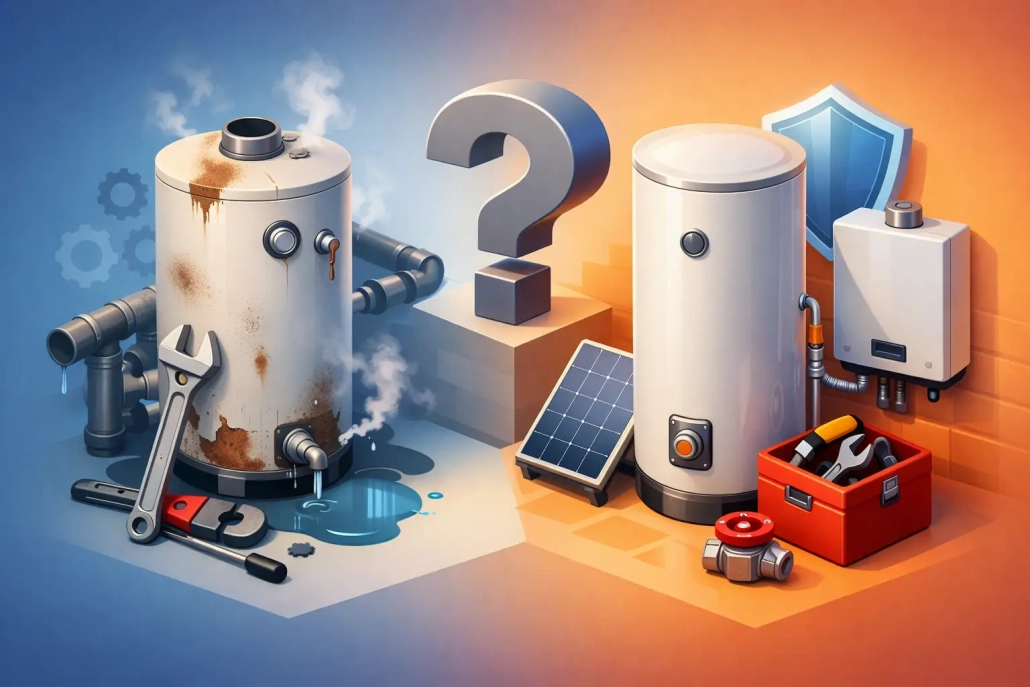
Cold water at 6 am usually settles the question fast, but not always the right one. When your system starts acting up, the real issue is whether to repair or replace hot water equipment before you spend money twice. A quick fix can be the smartest option in one home and a waste of money in the next, so it pays to look at the full picture before booking work.
When to repair or replace hot water
The best decision usually comes down to age, fault type, running costs and how reliable the unit has been lately. If a hot water system has been solid for years and suddenly needs a minor part replaced, repair often makes sense. If it is older, leaking from the tank, or failing more than once, replacement is usually the better long-term result.
That matters for homeowners and landlords alike. No one wants to pay for a repair on Monday and a full replacement on Friday. Tenants also need hot water restored quickly, so the practical choice is not always the cheapest invoice on the day.
Start with the age of the system
Age is one of the clearest indicators. Most storage hot water systems have a limited service life, and once they move into the later years, repair value drops. A unit that is eight to twelve years old may still be worth repairing if the fault is minor and the tank itself is sound. Once it gets beyond that range, especially in coastal and high-use conditions, you have to be realistic about what comes next.
Continuous flow systems can also become less economical to keep repairing as components wear out. They do not have a storage tank, which removes one major failure point, but valves, burners, sensors and heat exchangers can still become expensive as the unit ages.
If you do not know the age, the compliance plate or model details can usually point you in the right direction. For property managers, this is worth tracking before a breakdown happens.
The type of fault changes the answer
Not all hot water faults carry the same weight. Some are straightforward repairs. Others are a sign the system is on borrowed time.
A faulty thermostat, heating element, tempering valve, pressure limiting valve or pilot issue can often be repaired without replacing the whole unit. If the cylinder is in good condition and the repair cost is reasonable, that is often the sensible move.
A leaking tank is different. Once the tank itself has failed, replacement is generally the only real option. You might see water pooling around the base, rust marks, or a steady drop in performance before it gives out fully. At that point, putting money into parts around a failed tank rarely stacks up.
Discoloured hot water can also point to corrosion inside the system. Sometimes there is a simpler cause, but if rust is coming from an ageing tank, replacement is usually not far away.
Repair or replace hot water based on cost
Cost matters, but the cheapest decision on paper is not always the best value. A smaller repair bill can feel easier to swallow, but if it only buys a few more months, it may not actually save money.
A good rule of thumb is to compare the repair cost against the age and expected remaining life of the system. If the repair is minor and the unit should give you a few more solid years, repairing makes sense. If the repair is significant and the system is already near the end of its useful life, replacing it is often the more sensible spend.
There is also the hidden cost of repeated failures. Time off work, tenant complaints, emergency call-outs and the hassle of being without hot water all add up. For landlords and property managers, reliability is part of the cost equation, not a side issue.
Running costs should be part of the decision
Older systems can be expensive to run, especially ageing electric storage units. Even if they can be repaired, they may still be chewing through power and costing more month after month. Replacing an inefficient unit with a newer system can reduce ongoing energy use and give more reliable performance.
That does not mean replacement is automatically the right answer every time. If the household is small, hot water use is low and the existing unit only needs a minor repair, keeping it going may be perfectly reasonable. But if your bills have been climbing and the system struggles to keep up, replacement starts to look stronger.
Signs a repair is probably enough
There are plenty of situations where repair is the right call. If the unit is relatively young, the tank is sound, and the fault is limited to one serviceable component, a repair can be cost-effective and straightforward.
That often includes issues like inconsistent temperature, a tripped component, a worn valve or ignition trouble on a gas unit. In these cases, a licensed plumber can diagnose the problem properly and let you know if the repair is likely to hold or if it is just delaying the inevitable.
What you want is an honest assessment, not a guess. A proper inspection should look at the visible condition of the unit, signs of corrosion, performance history and whether parts are still available.
Signs replacement is the smarter move
If your hot water system is leaking from the tank, rusty, unreliable, undersized for the household, or breaking down repeatedly, replacement is usually the better path. The same goes if replacement parts are hard to source or the repair cost is edging too close to the price of a new unit.
Another common reason to replace is poor suitability. Sometimes the existing system is technically repairable, but it has never been a good fit for the property. A growing family may have outgrown a small storage tank. A rental property may need a more dependable setup with faster recovery. In those cases, replacing the unit solves more than one problem.
For homes across the Northern Gold Coast, practical factors like household size, tariff, available space and installation setup all affect the best replacement option. There is no one-size-fits-all answer.
Emergency breakdown versus planned replacement
There is a big difference between replacing a system after it fails and replacing it before it does. An emergency replacement often means making a fast decision under pressure because the house has no hot water. A planned replacement gives you time to compare options and avoid the stress.
If your existing system is clearly ageing and already showing signs of trouble, replacing it proactively can be the better move. That is especially true for landlords trying to avoid urgent tenant issues or homeowners who do not want a cold shower to make the decision for them.
What a plumber should help you weigh up
A good plumber should not push you one way without explaining why. The right advice comes from looking at the unit in front of them and balancing immediate cost against long-term value.
That includes the age of the system, the condition of the tank or heat exchanger, the fault involved, repair cost, hot water demand in the property and whether the system has had previous issues. It should also include practical details like compliance, safe installation and whether the replacement unit is the right size.
This is where experience matters. A local plumber who handles hot water repairs and replacements regularly can usually tell when a system is worth saving and when it is better not to throw more money at it.
Making the right call without overthinking it
Most people do not want a technical lesson. They want to know whether the system can be fixed properly, how long that fix is likely to last, and whether replacement is a better use of money.
That is the right way to approach it. If the repair is affordable and the unit still has good life left in it, repair it. If the system is old, leaking, inefficient or unreliable, replace it and move on with confidence.
For households, landlords and property managers, the best outcome is not just getting hot water back today. It is knowing the job has been handled properly, the advice was straight, and you are not likely to be dealing with the same problem again next month. That is the value of getting a licensed local plumber to assess the system properly and give you a clear answer.
If you are stuck deciding, the simplest test is this: ask whether the money you spend today is buying peace of mind or just buying time. That usually tells you what to do next.